
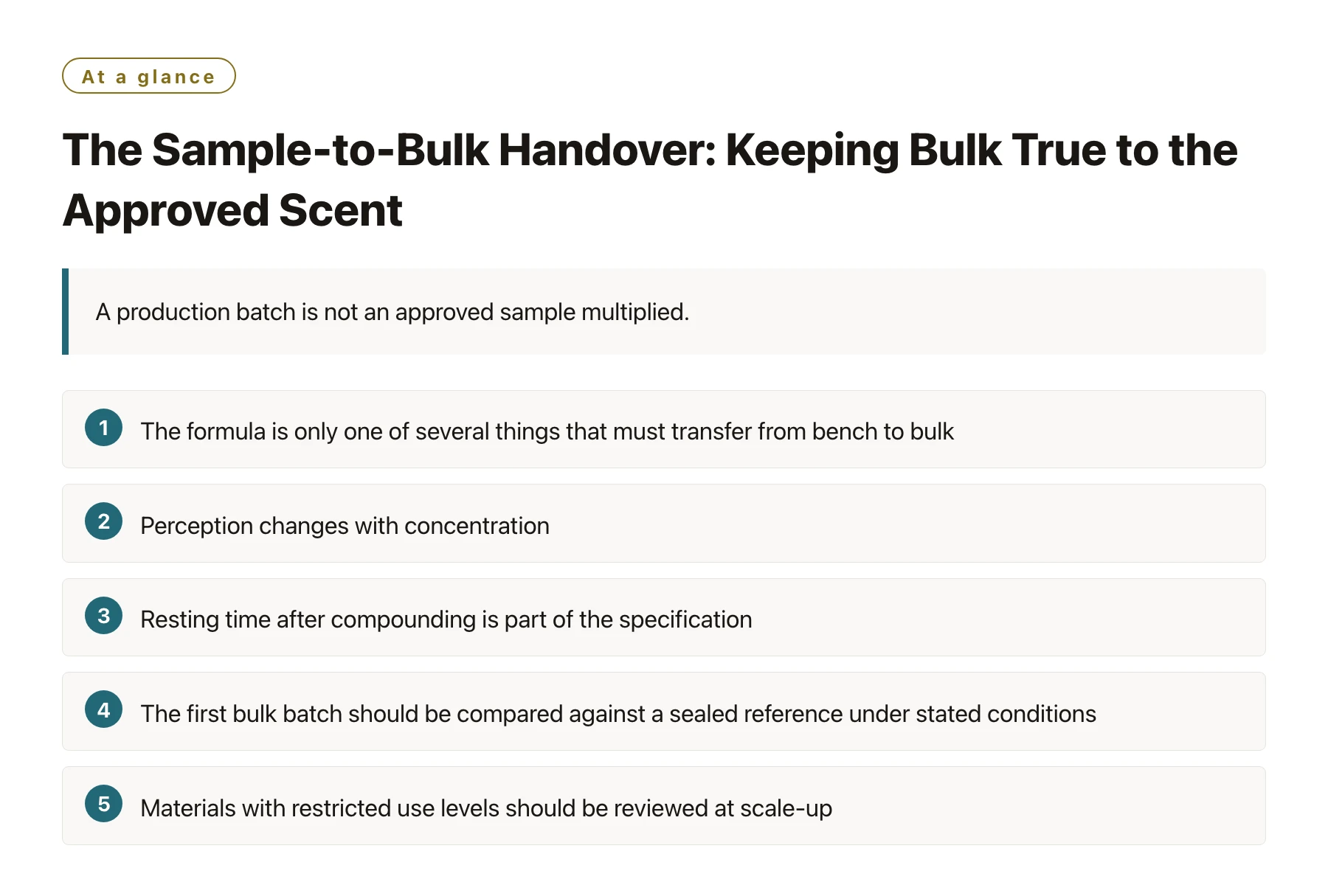
A production batch is not an approved sample multiplied. It is a different physical process, run in different equipment, by different people, on a different day. What keeps the two close is not care but a handover: a defined set of parameters and records that travel from the bench to the tank. Programmes that treat scale-up as a formality discover the gap after filling, when the only remedy is expensive. Programmes that treat it as an engineering event usually find the gap while it is still correctable.
Key takeaways
- The formula is only one of several things that must transfer from bench to bulk; process parameters and material lots matter just as much.
- Perception changes with concentration, so a compound that reads correctly at bench scale can read differently once it is diluted into a full batch.
- Resting time after compounding is part of the specification, not a scheduling convenience, and it should be stated in days.
- The first bulk batch should be compared against a sealed reference under stated conditions, with the comparison recorded rather than remembered.
- Materials with restricted use levels should be reviewed at scale-up, because lot variation can consume headroom that existed at bench scale.
- Three documents make the handover auditable: the process specification, the batch record and the reference comparison.
Most conversations about consistency happen after something has gone wrong. A brand receives a bulk delivery, compares it with the sample it approved, and senses a difference. The factory replies that the formula is identical, which is true and not the point.
Scale-up changes several things at once: batch size, mixing energy, order of addition, temperature profile, resting period, and the lot of each raw material. Any one of them can move the result. A handover is simply the practice of deciding, in advance, which of these are controlled and how you will know.
This article is written for the quality and product development side of a brand, and concentrates on what should be written down before the first tank is charged.
Why a scaled batch is a different object
On the bench, a compound is weighed in grams and blended in a beaker. In production, the same formula is weighed in kilograms or more and mixed in equipment whose geometry, agitation and thermal behaviour differ. Mixing efficiency is not linear with volume, so the time needed to reach a homogeneous blend changes with scale.
The consequences are not exotic. An under-mixed batch can show a faint top note where the bench showed a rounded opening. A batch held at a higher temperature for longer can age perceptibly before it ever reaches a bottle. None of this means the formula was wrong; it means the process was not specified.
Concentration changes perception, not just strength
Aroma materials are studied as chemistry as much as craft, and how a molecule is perceived depends on its concentration in the blend as well as on its structure [1]. That is why a small deviation in the level of one material can alter the character of a compound rather than simply making it louder or quieter.
For a buyer, the practical implication is that "the same formula" is a claim about inputs, not about outputs. The output is what a comparison against the reference tests.
Material lots are variables too
Natural materials in particular arrive with some variation between lots. Within a specified range that variation is normal and managed by the perfumery team. What should not be normal is a lot substitution made at scale-up without anyone reviewing whether the use level of a restricted material still sits comfortably within its limit [2].
This is a question worth asking explicitly before bulk production: has any material in this formula been substituted, and does the substitution change the restricted-material picture?
What has to cross the gap between bench and tank
| Parameter | Set at bench scale | Settled at bulk scale | How it is verified |
|---|---|---|---|
| Formula and materials | Approved formula version | Lots used for each material, with any substitution recorded | Batch record against the approved formula |
| Order of addition | Bench sequence | Production sequence, including any pre-dilution step | Signed process specification |
| Mixing and temperature | Bench conditions | Equipment-specific time, speed and temperature profile | Line record with in-process checks |
| Resting period | Bench rest before evaluation | Days allowed after compounding, before filling | Production plan and release record |
| Carrier and dilution | Small-scale ratio | Full-batch ratio including water and any functional ingredients | Finished formula check against the specification |
| Reference comparison | Approved sample retained | First bulk batch compared with the sealed reference | Written comparison, signed and dated |
The final row is the one that turns the rest into evidence. A comparison performed without a named reference, stated storage conditions and a signature is an opinion, and opinions are difficult to use in a conversation three months later.
The handover record: three documents worth insisting on
The first document is the process specification. It says how the batch is made, in the equipment that will make it, with numbers rather than adjectives. This is the document that makes a second batch possible without rebuilding knowledge from scratch.
The second is the batch record for the run itself: what was weighed, what was checked, who signed, and what exception was noted. The third is the reference comparison, which links the batch back to the sample the brand actually approved. Where accredited laboratory work is involved — stability, packaging compatibility or microbiological checks on the finished product — the report should be tied to a specific batch number, so that it can be matched to the record rather than filed separately [3].
These records are the same ones that travel with the product through later stages of production and testing, and many of the checks recorded at fill and finish lines are only meaningful because a bulk reference exists to compare against. The general sequence this belongs to is set out in from formula to finished bottle, where the bulk stage sits between compounding and packing.
The useful question before the first large run is therefore not "will you follow the formula" but "what will you send me, and when". A manufacturer that expects to send a batch record and a comparison note has a workflow for it.
Match the entity that signs with the entity that made it
The company name on the specification should be the company whose records and certificates you will rely on. It is worth checking that the entity publishing the manufacturer's own material is the same entity that appears on your batch record and on any test report issued for your product. On the site used as an example in this article, that name appears as Guangzhou Xuelei Cosmetic Co., Ltd.. A mismatch is not necessarily a problem, but it should be explained rather than discovered.
Agree the reference retain before the first run, not after it. Ask for at least two sealed units of the approved sample and two units of the first bulk batch, stored in the same conditions, with the storage condition written on the label. Then agree how a future comparison will be performed and by whom. This single piece of preparation resolves most disputes about consistency, because it converts a subjective argument into a documented check.
When bulk and sample disagree
Disagreement is normally resolvable, and the order in which you investigate matters. Check the reference first: a sample that has been stored badly is not a fair standard. Then compare the batch record against the process specification for substitutions, sequence changes and short rest periods. Only then examine the formula itself, because formula errors are the least common cause and the most expensive to assume.
Where the difference is small but real, there is a legitimate conversation about which version the brand prefers. Where the difference is large, it usually corresponds to a specific deviation in the record. Either way, the discussion runs on documents rather than on impressions.
If a brand expects to repeat this product across several runs, it is worth buying the process discipline as part of development rather than as an add-on to production. Broadly speaking, that is what a programme of custom fragrance R&D and production includes: the compound, the process specification and the checks that connect them.
Sources
- Chemistry World (Royal Society of Chemistry) —— The Royal Society of Chemistry's magazine, covering chemistry research and explanations of everyday materials including aroma compounds.
- IFRA Standards Library (International Fragrance Association) —— The IFRA Standards Library lists the restrictions the fragrance industry applies to individual fragrance ingredients, based on safety assessments; it is the reference point for compliant fragrance formulation.
- SGS: Cosmetics, Personal Care & Household Testing —— Testing, inspection and certification services for cosmetics and personal care, including microbiological, stability and safety testing aligned with cosmetics GMP.
Frequently asked questions
Why does my bulk order smell different from the sample I approved?
Common causes are an insufficient resting period after compounding, a different carrier ratio at production scale, a material lot substitution, or differences in mixing and temperature. Each of these is visible in the batch record, which is why the record is the first thing to request.
How long should a fragrance rest before filling?
The correct answer is the figure agreed in development and written into the specification — not a general number. What matters commercially is that the rest period appears in the production plan and in the release record, so it cannot be compressed quietly to meet a date.
What is a reference sample and how long should it be kept?
A sealed unit from an approved batch, stored under stated conditions and used to compare later production. At minimum, brands should hold one from the approved sample stage and one from the first bulk batch, and the manufacturer should hold equivalents. Retention periods are usually agreed in the supply terms.
Can scale-up changes push a formula past a restricted-material limit?
A formulation change or a lot substitution can reduce the remaining headroom on a restricted material, which is why the restricted picture should be reviewed whenever a material changes. Standards and their limits differ by product category, so the review is done against the finished product as it will be sold.
Should the brand attend the first bulk production run?
It is rarely necessary for every run and often useful for the first one. Being present at compounding, and seeing the batch record completed and the reference comparison performed, tells a brand more about a partner than any number of meetings.